25 de maio de 2016

Alimentos que combaten a resaca

Estudos realizados en diversas clínicas e universidades do mundo conclúen que o consumo de máis alcol ou café non axudan a eliminar a resaca, aínda que hai alimentos que si o fan.
As froitas e o mel, segundo investigacións realizadas na Clínica Cleveland de Ohio, conteñen azúcares que son capaces de eliminar o alcol do corpo. O salmón, os ovos e os lácteos, segundo a mesma clínica, son bos para combater a resaca, xa que conteñen altos niveis de vitaminas B6 e B12, que diminúen os seus efectos.
Os espárragos, segundo un estudo publicado pola revista The Journal of Food Science, conteñen aminoácidos e minerais que axudan a metabolizar o alcol e protexen as células do fígado fronte ao mesmo.
As bebidas deportivas axudan a hidratar o organismo e a subir o nivel de electrolitos, e a dieta BRAT, composta por arroz, plátanos, puré de mazá e pan torrado, permite eliminar a dor de estómago rapidamente producida pola resaca. Finalmente, o xenxibre alivia as náuseas e os mareos causados pola mesma.

Imaxe de muyinteresante.es

Fonte: http://www.muyinteresante.es/salud


23 de maio de 2016

Unha app para coñecer a calidade da cervexa

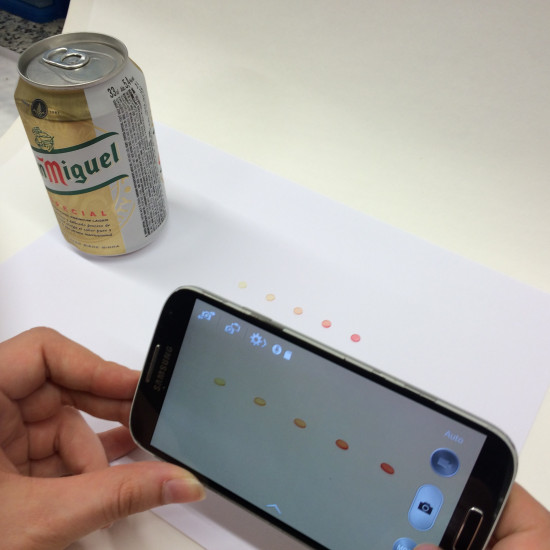
Un equipo de químicos coordinados por Elena Benito Peña e María Cruz Moreno Bondi da Universidade Complutense de Madrid, desenvolveron un sistema que permite medir se a cervexa está rancia.
Este sistema, rápido e de baixo custo, consta duns sensores dun polímero similar ao que se emprega para fabricar as lentes de contacto. Os sensores cambian de cor ao entrar en contacto coa cervexa, pasando de amarelo a rosa segundo a cantidade de furfural -composto químico que se forma cando a bebida envellece- que detecten. 
Mediante unha aplicación móbil, creada polo mesmo equipo, pódese coñecer exactamente a cantidade de furfural presente na bebida mediante a toma dunha fotografía. Considérase este un importante avance para a industria cervexeira, que tamén podería ser utilizado con outros alimentos como mel, leite, café...

Imaxe UCM


24 de xaneiro de 2016

Hoverboards come under fire


Last Christmas hoverboards were one of the most popular presents, but they came with a surprise, they get burnt. They can burn either when they are plugged in and charging or when someone is riding them, so they are very dangerous. Experts think their batteries are low- quality, they may have deffects, such as holes in their separator or impurities inside the battery. When big retailers, Amazon for example, have known about this problem, they decided to stop selling them for a time to prevent accidents.


From: // scienceworld.scholastic.com
Written by Alba Janeiro, 3rd A (9th grade)

Scientists create the toughest material yet discovered


Until now diamonds were considered the strongest material in nature, but scientists have created a new one harder than diamonds: the Q - carbon. This new material has also more properties: it glows even in the lowest light and it can be magnetized. For this reason it has many potential uses, like creating screens for gadgets or making artificial diamonds. However, scientists still have to investigate more about this new material.


From: http: //scienceworld.scholastic.com
Written by Sara Mirás, 3rd A ( 9th grade )

25 de novembro de 2015

A century of General Relativity

November 2015 marks an important date in the history of Physics because one hundred years ago, Albert Einstein wrote the equations of General Relativity.
The main idea of this theory is the fact that the space-time fabric is affected by the presence of matter.
 
In this video, Brian Greene explains complex concepts using simple terms.


19 de novembro de 2015

Pumpkin shortage

Pumpkin brand Libby's reports that unusually rainy weather in Illinois has affected the harvest of pumpkins negatively, but the company hopes to meet the needs of this year's holiday bakers. Pumpkins need warm weather to grow , but if there is too much rain, they don't get as big and they suffer more diseases.
Some climatologists affirm that the record rainfall in Illinois is related to climate change.

Pumpkins by Martin Doege ( Wikimedia)


From http: //scienceworld.scholastic.com/Earth-Science-News

Written by Sara Mirás, 3rd A ( 9th grade)