22 de marzo de 2015

Forgotten women scientists (II): Ada Lovelace

Ada Lovelace was a famous mathematician.
She was born on 10th December 1815 in England. Her father, Lord Byron, was a famous poet and her mother, Anne Isabelle Milbanke, was a mathematician.
She married William King and they had 3 children.
She loved music, poetry, dancing and any form of arts in general. However, her mother wanted her to have a higher education in maths and science.
 
Ada Byron
Image from wikipedia
 
She lived in the UK and she worked with Charles Babbage, a famous mathematician. He invented a machine to perform complex mathematical calculations. Ada Lovelace completed his device inventing codes to handle letters,symbols and numbers, so she was considered the first computer programmer.
She died in London in 1852. In her honor a software was named Ada in 1979.

From http://www.famous-mathematicians.com/ada-lovelace/
 
Written by Andrea Otero, Rosalía Rivera and Antía Varela - 3rd A (9th grade)


16 de marzo de 2015

Chronic insomniacs and hypertension

Some people take a lot of time to fall asleep. These people are insomniacs, and they have a bigger risk of hypertension when they take longer than 14 minutes to get to sleep. This study was developed at West China Hospital and it is the first one to test that hypertension is linked to insomnia.
 
This sleep disorder is the most common one in the general popupation and it was traditionally considered as a nighttime sleep disorder. However, a lot of studies suggest it is a 24-hours hyperarousal state, which doesn't allow people to feel well either during the day or at night.


From taringa.net

From http://www.sciencedaily.com/releases/2015/01/150126161759.htm

Written by Nora, Olalla and María - 3rd A (9th grade)


4 de febreiro de 2015

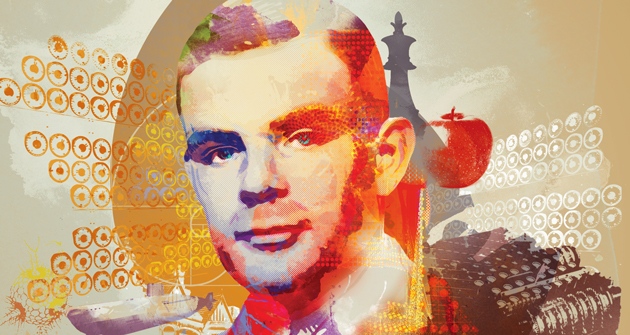
Code breaking: Alan Turing

Alan Turing was an excellent mathematician and logician. He was born in June 23, 1912 in London.
During World War II he joined the Government Codes and Cypher School at Bletchley Park, where he created a machine that broke the enemy codes and shortened the war by two years. Later on, after the war he was given the OBE, an award for his services to the country.
In 1950, Turing wrote a book about the notion of an universal machine which is now the central concept of the modern computer. Two years after, in 1952, he was persecuted for homosexual acts, since at that time such behaviour was illegal.
Unfortunately, on 8 June 1954 Turing's housekeeper found him dead from cyanide poisoning.
 
Image from www.nature.com


Written by Marisol Fernández, Noa García and Sofía López -   3rd A (9th grade).

23 de xaneiro de 2015

A plastic that recycles itself

Recycling electronic gadgdets is really difficult because it is not easy to separate their plastic components and dangerous to burn them.
Now researchers have invented new plastics which can be degraded exposing them to ultraviolet light. These new plastics dissolve into a clear solution after this exposition. Their small components can be used again to make other plastics, therefore we generate less waste and we reduce raw materials.
Researchers have to check if the use of light influences the properties of plastics, for instance, their strength or durability.

Written by Daniel Vázquez and Santiago Rojas - 3rd ESO (9th grade).

21 de xaneiro de 2015

UNESCO declares 2015 International Year of Light

UNESCO's International Years have been celebrated since 1959 and some are based on science topics, such as Physics, Astronomy or Chemistry.
This year UNESCO is celebrating the International Year of Light because in 2015 there are some anniversaries related to light: the notion of the wave nature of light is 200 years old, the development of electromagnetism is 150 years old and The General Relativity Theory, which includes the speed of light as an essential part, is 100 years old.
 
Image from http://www.eps.org/
 
The most significant aspect of this International Year is the fact that light connects many different fields such as Astronomy, Medicine, Arts and Technology.
There will be different events around the world in order to communicate the importance of light in our daily life.

From http://physicsworld.com

Written by Laura Blanco and Tania Conde - 3rd ESO (9th grade).


9 de xaneiro de 2015

Forgotten women scientists (I): Lise Meitner

Lise Meitner is a famous woman physicist who was born in Vienna in 1878. Her parents were Jewish and she had 7 brothers and sisters. As a child she was very good at science and math and she went to University where she studied physics.
 
Image from wikipedia.org

Meitner lived and worked in Austria, Germany, Sweden and UK. She worked with Otto Hahn for 30 years in Berlin. They both studied radioactivity and discovered the protactinium isotope. Later she became a physics professor at the University of Berlin, where she started her research on nuclear physics, discovering the nuclear fission in 1939. She carried out experiments on nuclear fission together with Hahn. He received the Physics Nobel Prize in 1944 for his scientific research into fission, but Meitner's research and discoveries were not recognised.
However, she received many different scientific awards and honors during her life.
She died in England in 1968 at the age of eighty-nine.


Written by Antía, Andrea and Rosalía - 3rd ESO (9th grade)